The most common denial codes in medical billing are CO-16 (missing information), CO-27 (coverage ended), CO-29 (filed too late), CO-50 (not medically necessary), CO-97 (bundled), CO-197 (no prior authorization) and CO-18 (duplicate). Most of them start at the front desk or in claim setup, so most of them can be prevented.
Every denied claim costs twice: once in the delay, and again in the staff time to work it. Industry estimates put the cost of reworking one denied claim at around $25 for a physician practice, and more than that for hospitals. Many denied claims are never resubmitted at all, so that money just disappears.
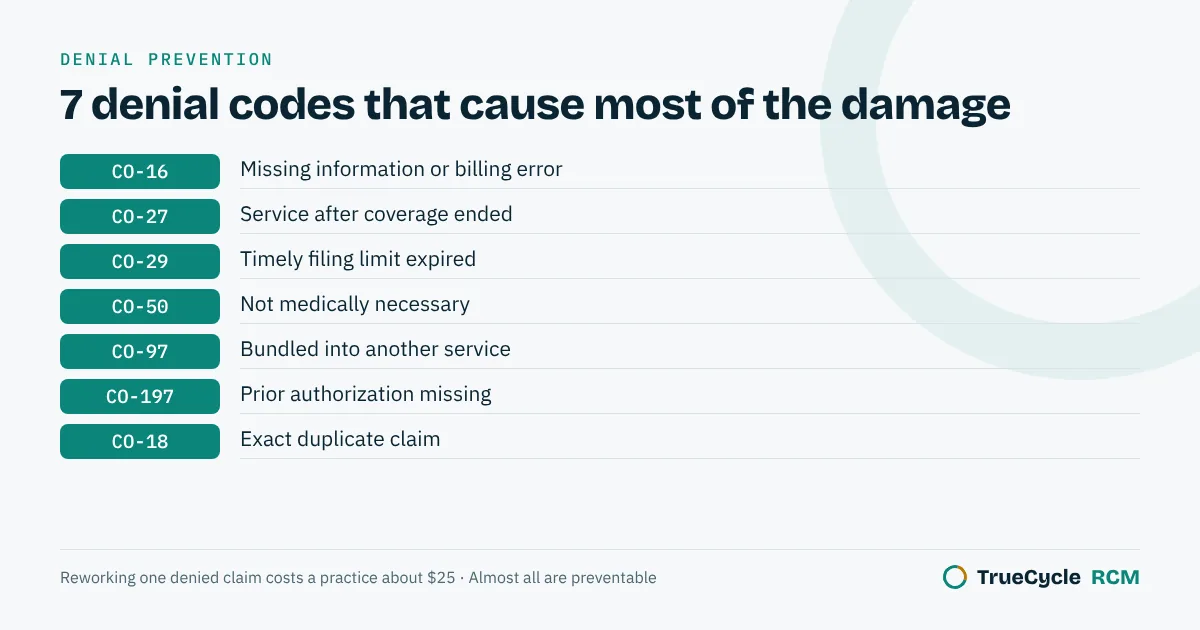
The good news is that the same handful of reason codes cause most of the damage, and almost all of them are preventable.
The quick list
| Code | What it means | Usual cause |
|---|---|---|
| CO-16 | Claim is missing information or has a billing error | Missing modifier, invalid NPI, wrong place of service, missing referring provider |
| CO-27 | Expenses incurred after coverage ended | Patient changed or lost insurance and the front desk used the old card |
| CO-29 | Time limit for filing has expired | Claim sat in a queue, or a rejection was never worked |
| CO-50 | Not deemed a medical necessity by the payer | Diagnosis does not support the service under the payer’s coverage policy |
| CO-97 | Service is included in another service already paid | Bundled procedures billed separately, missing or wrong modifier |
| CO-197 | Prior authorization or pre-certification absent | Service needed an auth that was never requested or has expired |
| CO-18 | Exact duplicate claim or service | Claim resubmitted instead of corrected, or billed twice by mistake |
"CO" means contractual obligation: the payer is saying the provider cannot bill the patient for this amount. That is why these denials hit your revenue directly.
What the latest data says about why claims get denied
Reason codes tell you what happened to one claim. Surveys tell you where denials come from across thousands of practices. Two recent ones point the same way: most denials start with data and paperwork, not with the care itself.
In Experian Health's State of Claims 2025 survey of 250 revenue cycle leaders, these were the top reasons for denials:
| Denial trigger | 2024 | 2025 | Codes you will usually see |
|---|---|---|---|
| Missing or wrong claim data | 46% | 50% | CO-16, MA130, CO-4 |
| Prior authorization | 36% | 35% | CO-197, CO-15 |
| Wrong or incomplete patient registration | 30% | 32% | CO-27, CO-31, CO-22 |
| Coding errors | 27% | 24% | CO-11, CO-97, CO-236 |
| Service not covered | 26% | 23% | PR-96, PR-204, CO-50 |
The same survey found that 54% of providers say claim errors are going up, and 68% say clean claims are harder to submit than a year ago. Percentages add up to more than 100% because people could pick more than one reason.
Insurer data tells a similar story. KFF looked at HealthCare.gov plans and found they denied about 20% of in-network claims in 2023. Where the plans gave a reason, administrative problems (21%) came up more often than excluded services (14%), missing prior authorization or referral (9%) or medical necessity (about 6%). And patients appealed fewer than 1% of those denials. In practice, if the billing team doesn't fix or appeal a denial, nobody will.
How to read a denial code on your ERA
On an 835 remittance or an EOB, a denial has two or three parts. Read them together, not one at a time.
| Part | Example | What it tells you |
|---|---|---|
| Group code | CO | Who owns the balance. CO = provider writes it off (contractual obligation). PR = patient owes it. OA = other adjustment, often a duplicate or a prior payer. PI = payer-initiated, no patient liability. |
| Claim adjustment reason code (CARC) | 16 | Why the line was adjusted or denied. |
| Remark code (RARC) | MA130, N290 | The detail: which field is missing or what to do next. This is usually where the real fix is. |
Example: CO-16 with N290 means the claim is missing or has an invalid rendering provider ID. You fix the NPI and send it again. You don't write an appeal. If reading 835 files line by line takes too long, our free 835 ERA reader turns them into plain English in your browser.
More codes billers see every week
These come up almost as often. Each one links to a full guide with the fix.
| Code | What it means |
|---|---|
| CO-4 | Procedure code needs a modifier, or the modifier is wrong |
| CO-26 | Service date is before the patient's coverage started |
| CO-31 | Payer could not match the patient to a member |
| CO-288 | Plan needed a referral and none was on file |
| CO-24 | Charge is covered under a capitation agreement |
| CO-11 | Diagnosis does not support the procedure |
| CO-22 | Another payer should pay first (coordination of benefits) |
| CO-45 | Charge is above the fee schedule or contract rate |
| PR-96 | Non-covered charge |
| CO-109 | Claim sent to the wrong payer or contractor |
| CO-151 | Payer thinks the number of services is too high |
| CO-236 | Procedure pair not allowed together (NCCI) |
| PR-204 | Service not covered under the patient's current plan |
| CO-B7 | Provider not enrolled on the date of service |
| N290 | Remark code: rendering provider NPI missing or invalid |
| N23 | Remark code: patient share changed by other insurance (alert) |
| CO-253 | Medicare sequestration cut (2%), not a denial |
| N130 | Remark code: check the plan's benefit rules |
| MA130 | Remark code: claim cannot be processed, fix and resubmit |
Search all 51 codes in our free denial code lookup.
How to prevent each one
CO-16: Claim is missing information or has a billing error
Usually caused by: Missing modifier, invalid NPI, wrong place of service, missing referring provider.
How to prevent it: Run every claim through scrubber edits before submission; fix and resubmit fast, it is usually correctable. Full CO-16 guide with remark codes →
CO-27: Expenses incurred after coverage ended
Usually caused by: Patient changed or lost insurance and the front desk used the old card.
How to prevent it: Re-verify eligibility before every visit, not just the first one. Ask every patient "has anything changed with your insurance?" at check-in. Full CO-27 guide →
CO-29: Time limit for filing has expired
Usually caused by: Claim sat in a queue, or a rejection was never worked.
How to prevent it: Track unbilled and rejected claims weekly against each payer’s filing limit (see our timely filing limits by payer list and calculator). Full CO-29 guide →
CO-50: Not deemed a medical necessity by the payer
Usually caused by: Diagnosis does not support the service under the payer’s coverage policy.
How to prevent it: Check coverage policies for high-cost services; make sure documentation and ICD-10 codes back up the CPT. For Medicare, the local coverage article (LCD) lists which diagnosis codes support the service. Full CO-50 guide →
CO-97: Service is included in another service already paid
Usually caused by: Bundled procedures billed separately, missing or wrong modifier.
How to prevent it: Apply NCCI edits and use modifiers like 25 or 59 only when documentation supports them. (Medicare has proposed a payment cut for modifier 25 visits in 2027.) Full CO-97 guide →
CO-197: Prior authorization or pre-certification absent
Usually caused by: Service needed an auth that was never requested or has expired.
How to prevent it: Keep a payer-by-payer auth list and check auth status at scheduling. If the service was urgent, ask the payer about a retro authorization before you appeal. Full CO-197 guide →
CO-18: Exact duplicate claim or service
Usually caused by: Claim resubmitted instead of corrected, or billed twice by mistake.
How to prevent it: Check claim status before resubmitting; send corrections as corrected claims, not new ones. (Many payers report a duplicate as OA-18 instead of CO-18.)
Send us the list: payer, date of service, denial code and amount. No patient names needed. We will tell you which claims can still be fixed, which need an appeal, and which deadlines are close. Free, usually within 2 business days. Want the full picture? Get a free 90-day denial audit from your ERA files.
Run a billing company? Add a trained biller from $8/hour, first 25 claims free.
Fix, appeal or bill the patient? A quick guide
The biggest time-waster in denial work is sending an appeal for a denial that only needed a corrected claim. Use the group code and the reason to pick the right path first.
| What to do | Typical codes | Why |
|---|---|---|
| Correct and resubmit | CO-16, CO-4, CO-11, CO-22, CO-27, CO-109, MA130 | Something on the claim was wrong or missing. Fix it, then send a corrected claim (frequency code 7) or a new claim, as the payer asks. |
| Appeal with records | CO-50, CO-97, CO-151, CO-197 (with retro auth), CO-236 | The claim was right, but the payer needs proof: notes, auth, or why a modifier applies. |
| Bill the patient or the secondary | PR-1, PR-2, PR-3, PR-96, PR-204 | The plan processed it correctly and the balance belongs to the patient (check your ABN or waiver for non-covered services). |
| Adjust off | CO-45, CO-29 (if no proof of timely filing), CO-18/OA-18 | Contract write-off or a duplicate. Don't bill the patient for CO amounts. |
The habit that fixes most of them
Look at your denials every week, grouped by reason code. If one code shows up again and again, the fix is usually upstream: a front-desk step, a missing auth list or a template in the EHR. Fixing the process once beats appealing the same denial fifty times.
A practical target is a clean-claim rate above 95% and a denial rate under 5%. If you're not sure where your practice stands, that is the first number worth finding out.
Common questions
What is the most common denial code in medical billing?
CO-16 is one of the most common. It means the claim is missing information or has a billing error, such as an invalid NPI, a missing modifier or the wrong place of service. Its remark code (for example MA130 or N290) tells you exactly what to fix.
What does CO mean in a denial code?
CO stands for contractual obligation. It means the provider has to absorb the amount and cannot bill the patient for it. PR means patient responsibility, OA means other adjustment and PI means payer-initiated reduction.
What percentage of claims get denied?
It depends on the payer and the practice. KFF found that HealthCare.gov plans denied about 20% of in-network claims in 2023. Many practices aim for a denial rate under 5% and a clean-claim rate above 95%.
Can denied claims be fixed without an appeal?
Yes. Denials for missing or wrong information, like CO-16, CO-4 or MA130, are usually fixed by correcting the claim and sending it again. Appeals are for denials where the claim was right but the payer disagrees, like medical necessity (CO-50) or bundling (CO-97).
How long do you have to fix a denied claim?
You have the payer's timely filing limit for corrected claims and its appeal window for appeals. These differ by payer. Medicare allows 120 days to request a redetermination, and many commercial plans allow 180 days. Check our timely filing limits by payer page for each plan.
Sources: Experian Health, State of Claims 2025 (survey of 250 healthcare professionals, June 23 to July 3, 2025) · KFF, Claims Denials and Appeals in ACA Marketplace Plans in 2023 · X12 claim adjustment reason and remark code lists.
Want a second pair of eyes on your claims?
We review 25 of your claims free, then tell you where the money is leaking. No setup fee, month-to-month.
Start the free 25-claim trialFiling limits, appeal windows and claim addresses change quietly. Get one short email a month with what changed and the free tools we add.
One email a month. No spam. Unsubscribe any time.More guides from our blog
- E/M downcoding: how to spot 99214 and 99215 cuts and get paid
- Corrected claim timely filing limits for 2026, payer by payer
- Aetna timely filing limit for 2026: new claims, corrected claims, appeals and Medicare
- Cigna and HealthSpring timely filing limit for 2026: new claims, corrected claims, appeals
- HealthSpring timely filing limit for 2026: claims, corrected claims and appeals
- Humana timely filing limit for 2026: claims, corrected claims and appeals
- 190 new ICD-10 codes went live on October 1. Here's what breaks first on your claims.
- How much does medical billing cost in 2026? In-house vs outsourced, in real numbers
- Modifier 25 in 2027: what Medicare’s proposed 50% cut looks like in dollars
- Provider credentialing in medical billing: timelines, documents and CAQH in 2026
- Timely filing limits by payer for 2026, checked against each payer’s own manual
- UnitedHealthcare timely filing limit for 2026: claims, corrected claims and appeals
Free tools
- Payer claim addresses and fax numbers
- Free 835 ERA reader
- Denial code lookup
- Timely filing calculator
- Credentialing timeline calculator
Reason codes are standard Claim Adjustment Reason Codes (CARC) maintained by X12. Payer rules vary, so always check the specific payer's policy.